Multivariate regression refers to the simultaneous examination of a
single independent predictor across multiple dependent variables. This
approach inverts the typical regression paradigm: rather than testing
multiple predictors against one outcome (as in uniscreen(),
fit(), and fullfit()), multivariate regression
tests the predictive value of a individual factor against multiple
outcomes, with or without multivariable adjustment for other independent
factors. This design is particularly useful when a key exposure or
intervention must be evaluated against several endpoints
simultaneously.
The multifit() function implements this workflow,
supporting all model types available in summata with
optional covariate adjustment, interaction terms, and mixed-effects
specifications. Results can be visualized using
multiforest() and exported using standard table export
functions.
As with other summata functions, this function adheres
to the standard calling convention:
multifit(data, outcomes, predictor, covariates, model_type, ...)where data is the dataset, outcomes is a
vector of screened outcome variables, predictor is the
predicting variable under examination, covariates is a
vector of simultaneous independent predicting variables (i.e., potential
confounders), and model_type is the type of model to be
implemented. This vignette demonstrates the various capabilities of this
function using the included sample dataset.
Preliminaries
The examples in this vignette use the clintrial dataset
included with summata:
The clintrial dataset includes multiple outcome types
suitable for multivariate analysis:
| Outcome Type | Variables | Model |
|---|---|---|
| Continuous |
los_days, pain_score,
recovery_days
|
lm |
| Binary |
any_complication,
wound_infection, readmission_30d,
icu_admission
|
glm (binomial) |
| Count (equidispersed) | fu_count |
glm (poisson) |
| Count (overdispersed) | ae_count |
negbin or quasipoisson
|
| Time-to-event |
Surv(pfs_months, pfs_status),
Surv(os_months, os_status)
|
coxph |
n.b.: The forest plots below are sized by this vignette from each plot’s recommended dimensions, stored in its
"rec_dims"attribute, and rendered via theragggraphics device for correct font metrics. That sizing is applied behind the scenes and is not shown in the code. Writing a plot to file elsewhere is performed withforestsave(), which applies the same dimensions and selects a suitable graphics device:p <- glmforest(model, data = mydata) forestsave(p, "forest_plot.png")This ensures that the figure size is always large enough to accommodate the constituent plot text and graphics, and it is the preferred method for saving forest plot outputs in
summata.
Basic Usage
Example 1: Unadjusted Analysis
Test a single predictor against multiple binary outcomes:
example1 <- multifit(
  data = clintrial,
  outcomes = c("any_complication", "wound_infection",
               "readmission_30d", "icu_admission"),
  predictor = "surgery",
  labels = clintrial_labels,
  parallel = FALSE
)

example1
##>
##> Multivariate Regression Results
##>
##> Predictor: surgery
##> Outcomes: 4
##> Model Type: glm
##> Display: unadjusted
##> Observations analyzed: 850 of 850 (100.0%)
##>
##>                   Outcome          Predictor      n Events      OR (95% CI) p-value
##>                    <char>             <char> <char> <char>           <char>  <char>
##> 1:       Any Complication Surgical Resection    370    236 1.70 (1.29-2.25) < 0.001
##> 2:   Wound/Site Infection Surgical Resection    370    121 4.58 (3.18-6.72) < 0.001
##> 3:     30-Day Readmission Surgical Resection    370    181 0.91 (0.69-1.19)   0.500
##> 4: ICU Admission Required Surgical Resection    370    179 2.25 (1.70-2.99) < 0.001
Each row shows the effect of the predictor on a specific outcome. For categorical predictors, each non-reference level appears separately.
Example 2: Adjusted Analysis
Include covariates for confounding control:
example2 <- multifit(
  data = clintrial,
  outcomes = c("any_complication", "wound_infection",
               "readmission_30d", "icu_admission"),
  predictor = "surgery",
  covariates = c("age", "sex", "smoking", "diabetes"),
  labels = clintrial_labels,
  parallel = FALSE
)

example2
##>
##> Multivariate Regression Results
##>
##> Predictor: surgery
##> Outcomes: 4
##> Model Type: glm
##> Covariates: age, sex, smoking, diabetes
##> Display: adjusted
##> Observations analyzed: 833 of 850 (98.0%)
##>
##>                   Outcome          Predictor      n Events     aOR (95% CI) p-value
##>                    <char>             <char> <char> <char>           <char>  <char>
##> 1:       Any Complication Surgical Resection    362    229 1.84 (1.38-2.48) < 0.001
##> 2:   Wound/Site Infection Surgical Resection    362    117 5.21 (3.50-7.87) < 0.001
##> 3:     30-Day Readmission Surgical Resection    362    176 1.07 (0.80-1.43)   0.641
##> 4: ICU Admission Required Surgical Resection    362    173 2.56 (1.90-3.47) < 0.001
Example 3: Unadjusted and Adjusted Comparison
Use columns = "both" to display unadjusted and adjusted
results side-by-side:
example3 <- multifit(
  data = clintrial,
  outcomes = c("any_complication", "wound_infection",
               "readmission_30d", "icu_admission"),
  predictor = "surgery",
  covariates = c("age", "sex", "diabetes", "surgery"),
  columns = "both",
  labels = clintrial_labels,
  parallel = FALSE
)

example3
##>
##> Multivariate Regression Results
##>
##> Predictor: surgery
##> Outcomes: 4
##> Model Type: glm
##> Covariates: age, sex, diabetes, surgery
##> Display: both
##> Observations analyzed: 834 of 850 (98.1%)
##>
##>                   Outcome          Predictor      n Events      OR (95% CI)   Uni p     aOR (95% CI) Multi p
##>                    <char>             <char> <char> <char>           <char>  <char>           <char>  <char>
##> 1:       Any Complication Surgical Resection    362    229 1.70 (1.29-2.25) < 0.001 1.82 (1.36-2.44) < 0.001
##> 2: ICU Admission Required Surgical Resection    362    173 2.25 (1.70-2.99) < 0.001 2.57 (1.91-3.48) < 0.001
##> 3:     30-Day Readmission Surgical Resection    362    176 0.91 (0.69-1.19)   0.500 1.05 (0.79-1.40)   0.720
##> 4:   Wound/Site Infection Surgical Resection    362    117 4.58 (3.18-6.72) < 0.001 4.98 (3.37-7.46) < 0.001
Comparing columns reveals confounding (large differences) or robust associations (similar estimates).
Predictor Types
Example 4: Continuous Predictors
For continuous predictors, one row appears per outcome:
example4 <- multifit(
  data = clintrial,
  outcomes = c("any_complication", "wound_infection", "icu_admission"),
  predictor = "age",
  covariates = c("sex", "treatment", "surgery"),
  labels = clintrial_labels,
  parallel = FALSE
)

example4
##>
##> Multivariate Regression Results
##>
##> Predictor: age
##> Outcomes: 3
##> Model Type: glm
##> Covariates: sex, treatment, surgery
##> Display: adjusted
##> Observations analyzed: 850 of 850 (100.0%)
##>
##>                   Outcome      n Events     aOR (95% CI) p-value
##>                    <char> <char> <char>           <char>  <char>
##> 1:       Any Complication    850    480 1.01 (1.00-1.03)   0.024
##> 2:   Wound/Site Infection    850    167 1.01 (0.99-1.02)   0.338
##> 3: ICU Admission Required    850    320 1.03 (1.02-1.04) < 0.001
The effect estimate represents the change in log-odds per one-unit increase in the predictor.
Example 5: Multilevel Categorical Predictors
For categorical predictors with multiple levels, the display is expanded:
example5 <- multifit(
  data = clintrial,
  outcomes = c("any_complication", "wound_infection",
               "readmission_30d", "icu_admission"),
  predictor = "treatment",
  covariates = c("age", "sex", "surgery"),
  labels = clintrial_labels,
  parallel = FALSE
)

example5
##>
##> Multivariate Regression Results
##>
##> Predictor: treatment
##> Outcomes: 4
##> Model Type: glm
##> Covariates: age, sex, surgery
##> Display: adjusted
##> Observations analyzed: 850 of 850 (100.0%)
##>
##>                   Outcome                Predictor      n Events     aOR (95% CI) p-value
##>                    <char>                   <char> <char> <char>           <char>  <char>
##> 1:       Any Complication Treatment Group (Drug A)    292    143 0.66 (0.45-0.96)   0.031
##> 2:       Any Complication Treatment Group (Drug B)    362    226 1.48 (1.03-2.14)   0.035
##> 3:   Wound/Site Infection Treatment Group (Drug A)    292     72 1.90 (1.16-3.21)   0.013
##> 4:   Wound/Site Infection Treatment Group (Drug B)    362     69 2.26 (1.36-3.85)   0.002
##> 5:     30-Day Readmission Treatment Group (Drug A)    292    127 0.86 (0.59-1.24)   0.415
##> 6:     30-Day Readmission Treatment Group (Drug B)    362    209 1.61 (1.12-2.32)   0.010
##> 7: ICU Admission Required Treatment Group (Drug A)    292    111 1.11 (0.75-1.65)   0.615
##> 8: ICU Admission Required Treatment Group (Drug B)    362    145 1.70 (1.16-2.52)   0.007
Model Types
Example 6: Cox Regression
For time-to-event outcomes, use
model_type = "coxph":
example6 <- multifit(
  data = clintrial,
  outcomes = c("Surv(pfs_months, pfs_status)",
               "Surv(os_months, os_status)"),
  predictor = "treatment",
  covariates = c("age", "sex", "stage"),
  model_type = "coxph",
  labels = clintrial_labels,
  parallel = FALSE
)

example6
##>
##> Multivariate Regression Results
##>
##> Predictor: treatment
##> Outcomes: 2
##> Model Type: coxph
##> Covariates: age, sex, stage
##> Display: adjusted
##> Observations analyzed: 847 of 850 (99.6%)
##>
##>                               Outcome                Predictor      n Events     aHR (95% CI) p-value
##>                                <char>                   <char> <char> <char>           <char>  <char>
##> 1: Progression-Free Survival (months) Treatment Group (Drug A)    292    227 0.54 (0.44-0.66) < 0.001
##> 2: Progression-Free Survival (months) Treatment Group (Drug B)    361    321 0.82 (0.68-0.98)   0.033
##> 3:          Overall Survival (months) Treatment Group (Drug A)    292    184 0.56 (0.45-0.70) < 0.001
##> 4:          Overall Survival (months) Treatment Group (Drug B)    361    273 0.83 (0.67-1.01)   0.062
Example 7: Linear Regression
For continuous outcomes, use model_type = "lm":
example7 <- multifit(
  data = clintrial,
  outcomes = c("los_days", "pain_score", "recovery_days"),
  predictor = "treatment",
  covariates = c("age", "sex", "surgery"),
  model_type = "lm",
  labels = clintrial_labels,
  parallel = FALSE
)

example7
##>
##> Multivariate Regression Results
##>
##> Predictor: treatment
##> Outcomes: 3
##> Model Type: lm
##> Covariates: age, sex, surgery
##> Display: adjusted
##> Observations analyzed: 830-840 of 850 (97.6-98.8%)
##>
##>                            Outcome                Predictor      n Adj. Coefficient (95% CI) p-value
##>                             <char>                   <char> <char>                    <char>  <char>
##> 1:  Length of Hospital Stay (days) Treatment Group (Drug A)    288    -1.07 (-1.83 to -0.32)   0.006
##> 2:  Length of Hospital Stay (days) Treatment Group (Drug B)    350       3.10 (2.36 to 3.83) < 0.001
##> 3: Postoperative Pain Score (0-10) Treatment Group (Drug A)    289    -0.56 (-0.84 to -0.27) < 0.001
##> 4: Postoperative Pain Score (0-10) Treatment Group (Drug B)    359       0.86 (0.59 to 1.13) < 0.001
##> 5:     Days to Functional Recovery Treatment Group (Drug A)    288    -1.73 (-2.96 to -0.50)   0.006
##> 6:     Days to Functional Recovery Treatment Group (Drug B)    352       2.79 (1.59 to 3.98) < 0.001
The three outcomes are not fitted to the same observations. Length of
stay is unrecorded for a proportion of patients who did not undergo
surgical resection, whereas pain score and days to recovery are
complete. Each model is therefore fitted to its own complete cases, and
the analyzed sample is reported as a range spanning the three models
rather than as a single figure. Sample sizes in the n
column vary correspondingly.
Missingness of this kind is related to a variable in the model rather than occurring at random, and the estimates for length of stay describe the subset of patients for whom it was recorded. The range in the header is the signal that this subset differs from the others.
Example 8: Mixed-Effects Models
Account for clustering using random effects:
example8 <- multifit(
  data = clintrial,
  outcomes = c("any_complication", "wound_infection"),
  predictor = "treatment",
  covariates = c("age", "sex"),
  random = "(1|site)",
  model_type = "glmer",
  labels = clintrial_labels,
  parallel = FALSE
)

example8
##>
##> Multivariate Regression Results
##>
##> Predictor: treatment
##> Outcomes: 2
##> Model Type: glmer
##> Covariates: age, sex
##> Random Effects: (1|site)
##> Display: adjusted
##> Observations analyzed: 850 of 850 (100.0%)
##>
##>                 Outcome                Predictor      n Events     aOR (95% CI) p-value
##>                  <char>                   <char> <char> <char>           <char>  <char>
##> 1:     Any Complication Treatment Group (Drug A)    292    143 0.74 (0.51-1.06)   0.104
##> 2:     Any Complication Treatment Group (Drug B)    362    226 1.29 (0.90-1.84)   0.170
##> 3: Wound/Site Infection Treatment Group (Drug A)    292     72 2.17 (1.32-3.57)   0.002
##> 4: Wound/Site Infection Treatment Group (Drug B)    362     69 1.62 (0.99-2.66)   0.055
Advanced Features
Example 9: Interaction Terms
Interaction terms can be added to test effect modification:
example9 <- multifit(
  data = clintrial,
  outcomes = c("any_complication", "wound_infection"),
  predictor = "treatment",
  covariates = c("age", "sex"),
  interactions = c("treatment:sex"),
  labels = clintrial_labels,
  parallel = FALSE
)

example9
##>
##> Multivariate Regression Results
##>
##> Predictor: treatment
##> Outcomes: 2
##> Model Type: glm
##> Covariates: age, sex
##> Interactions: treatment:sex
##> Display: adjusted
##> Observations analyzed: 850 of 850 (100.0%)
##>
##>                 Outcome                             Predictor      n Events     aOR (95% CI) p-value
##>                  <char>                                <char> <char> <char>           <char>  <char>
##> 1:     Any Complication              Treatment Group (Drug A)    292    143 0.63 (0.38-1.04)   0.074
##> 2:     Any Complication              Treatment Group (Drug B)    362    226 1.27 (0.78-2.08)   0.340
##> 3:     Any Complication Treatment Group (Drug A) × Sex (Male)      -      - 1.41 (0.68-2.93)   0.360
##> 4:     Any Complication Treatment Group (Drug B) × Sex (Male)      -      - 0.99 (0.48-2.00)   0.968
##> 5: Wound/Site Infection              Treatment Group (Drug A)    292     72 2.20 (1.16-4.41)   0.020
##> 6: Wound/Site Infection              Treatment Group (Drug B)    362     69 1.30 (0.67-2.64)   0.455
##> 7: Wound/Site Infection Treatment Group (Drug A) × Sex (Male)      -      - 0.93 (0.34-2.52)   0.884
##> 8: Wound/Site Infection Treatment Group (Drug B) × Sex (Male)      -      - 1.43 (0.54-3.87)   0.472
Example 10: Filtering by p-value
Outputs can be filtered to retain only significant associations:
example10 <- multifit(
  data = clintrial,
  outcomes = c("any_complication", "wound_infection",
               "readmission_30d", "icu_admission"),
  predictor = "treatment",
  covariates = c("age", "sex", "surgery"),
  p_threshold = 0.01,
  labels = clintrial_labels,
  parallel = FALSE
)

example10
##>
##> Multivariate Regression Results
##>
##> Predictor: treatment
##> Outcomes: 4
##> Model Type: glm
##> Covariates: age, sex, surgery
##> Display: adjusted
##> Observations analyzed: 850 of 850 (100.0%)
##>
##>                   Outcome                Predictor      n Events     aOR (95% CI) p-value
##>                    <char>                   <char> <char> <char>           <char>  <char>
##> 1:   Wound/Site Infection Treatment Group (Drug B)    362     69 2.26 (1.36-3.85)   0.002
##> 2:     30-Day Readmission Treatment Group (Drug B)    362    209 1.61 (1.12-2.32)   0.010
##> 3: ICU Admission Required Treatment Group (Drug B)    362    145 1.70 (1.16-2.52)   0.007
Example 11: Accessing Model Objects
Underlying model objects are stored as attributes for additional analysis:
result <- multifit(
  data = clintrial,
  outcomes = c("any_complication", "wound_infection"),
  predictor = "treatment",
  covariates = c("age", "sex"),
  labels = clintrial_labels,
  keep_models = TRUE,
  parallel = FALSE
)

# Access individual models
models <- attr(result, "models")
names(models)
##> [1] "any_complication" "wound_infection"

# Examine a specific model
summary(models[["any_complication"]])
##>          Length Class Mode
##> adjusted 30     glm   list
Forest Plot Visualization
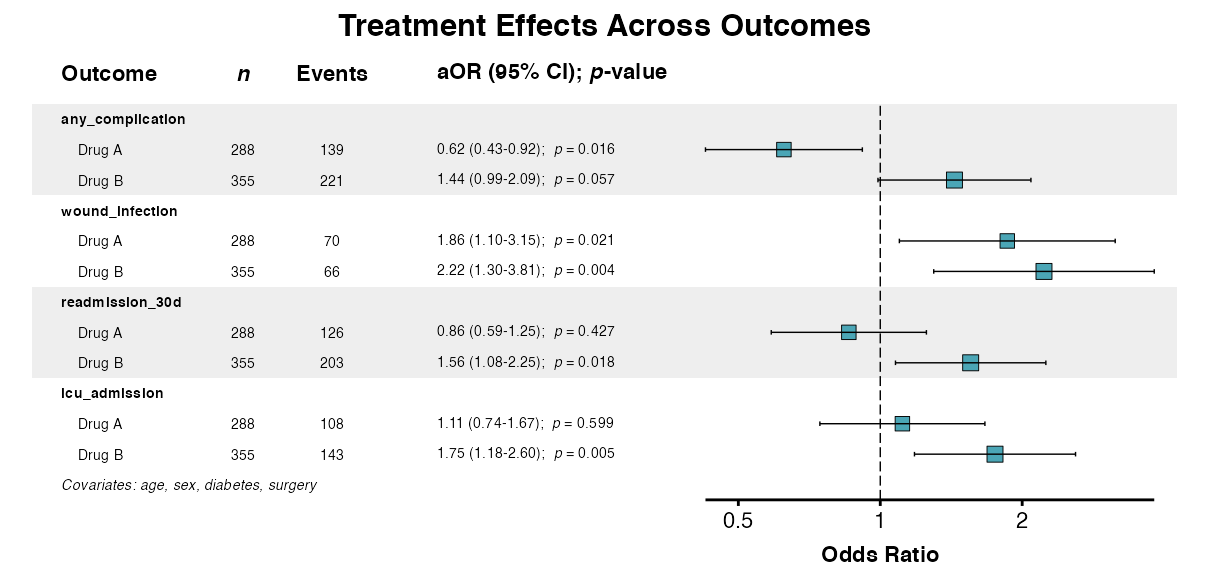
The multiforest() function creates forest plots from
multifit() results.
Example 12: Forest Plot for Logistic (Binary) Outcomes
Results from multifit() can be directly inserted into
the multiforest() function to generate a forest plot:
result <- multifit(
  data = clintrial,
  outcomes = c("any_complication", "wound_infection",
               "readmission_30d", "icu_admission"),
  predictor = "treatment",
  covariates = c("age", "sex", "diabetes", "surgery"),
  labels = clintrial_labels,
  parallel = FALSE
)

example12 <- multiforest(
  result,
  title = "Treatment Effects Across Outcomes",
  indent_predictor = TRUE,
  zebra_stripes = TRUE
)
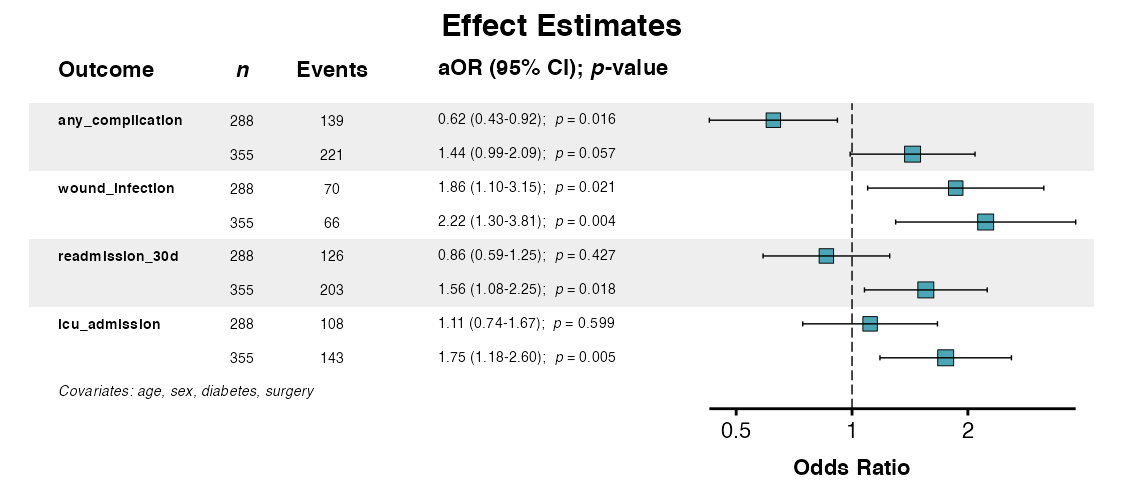
Example 13: Customization Options
Customize the appearance of the forest plot by adjusting function parameters:
example13 <- multiforest(
  result,
  title = "Effect Estimates",
  column = "adjusted",
  show_predictor = FALSE,
  covariates_footer = TRUE,
  table_width = 0.65,
  color = "#4BA6B6"
)
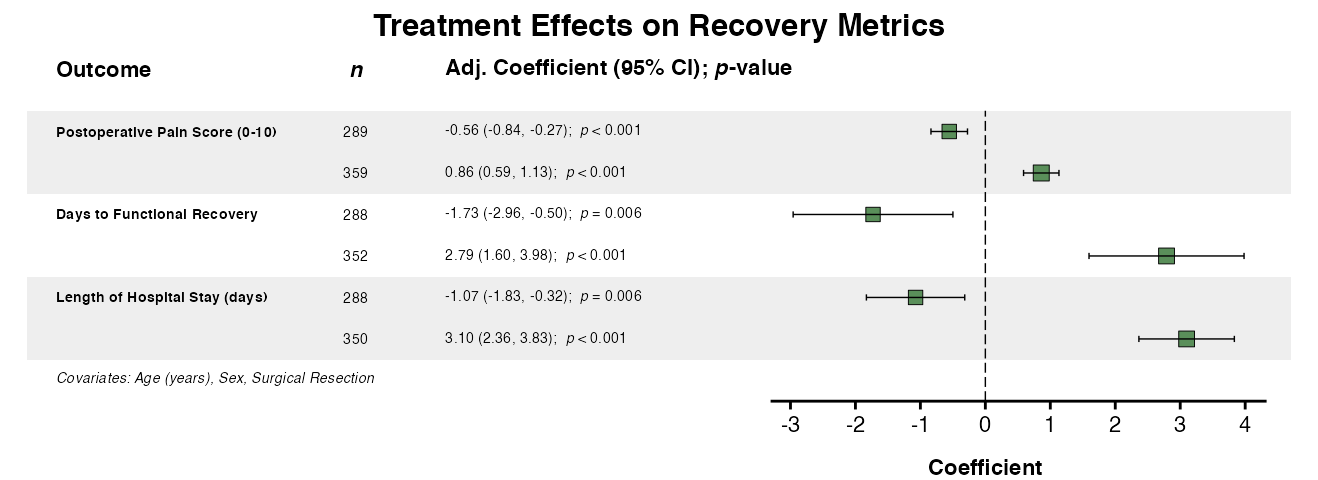
Example 14: Forest Plot for Continuous Outcomes
Create forest plots for continuous outcomes:
lm_result <- multifit(
  data = clintrial,
  outcomes = c("pain_score", "recovery_days", "los_days"),
  predictor = "treatment",
  covariates = c("age", "sex", "surgery"),
  model_type = "lm",
  parallel = FALSE
)

example14 <- multiforest(
  lm_result,
  title = "Treatment Effects on Recovery Metrics",
  show_predictor = FALSE,
  covariates_footer = TRUE,
  labels = clintrial_labels
)
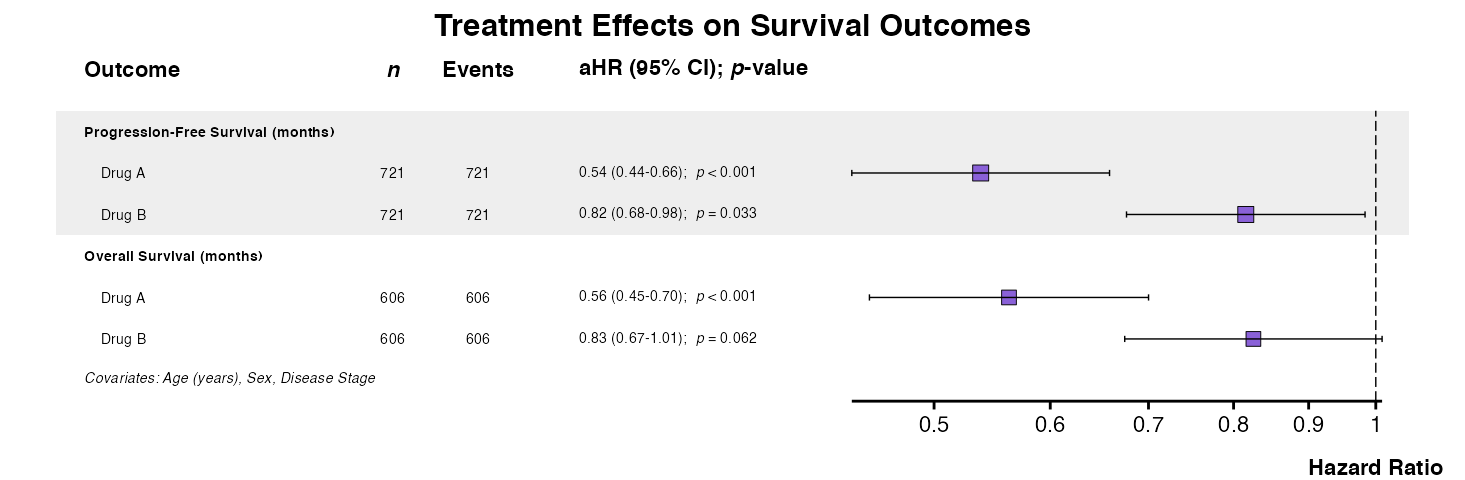
Example 15: Forest Plot for Survival Outcomes
The multiforest() function supports multiple
model_type outputs from multifit(). In
addition, variable labels can be applied to multiforest()
outputs similarly to other forest plot functions:
cox_result <- multifit(
  data = clintrial,
  outcomes = c("Surv(pfs_months, pfs_status)",
               "Surv(os_months, os_status)"),
  predictor = "treatment",
  covariates = c("age", "sex", "stage"),
  model_type = "coxph",
  parallel = FALSE
)

example15 <- multiforest(
  cox_result,
  title = "Treatment Effects on Survival Outcomes",
  indent_predictor = TRUE,
  zebra_stripes = TRUE,
  labels = clintrial_labels
)
Exporting Results
Tables
Export tables using standard export functions, or
tablesave():
table2docx(
  table = result,
  file = "multioutcome_analysis.docx",
  caption = "Treatment Effects Across Outcomes"
)

table2pdf(
  table = result,
  file = "multioutcome_analysis.pdf",
  caption = "Treatment Effects Across Outcomes"
)
Forest Plots
Save forest plots using the dedicated multiforest()
function, then forestsave():
p <- multiforest(result, title = "Effect Estimates")

forestsave(p, "multioutcome_forest.pdf")
Complete Workflow Example
The following demonstrates a complete multi-outcome analysis workflow:
## Define outcomes by type
binary_outcomes <- c("any_complication", "wound_infection",
                     "readmission_30d", "icu_admission")
survival_outcomes <- c("Surv(pfs_months, pfs_status)",
                       "Surv(os_months, os_status)")

## Unadjusted screening
unadjusted <- multifit(
  data = clintrial,
  outcomes = binary_outcomes,
  predictor = "treatment",
  labels = clintrial_labels,
  parallel = FALSE
)

unadjusted
##>
##> Multivariate Regression Results
##>
##> Predictor: treatment
##> Outcomes: 4
##> Model Type: glm
##> Display: unadjusted
##> Observations analyzed: 850 of 850 (100.0%)
##>
##>                   Outcome                Predictor      n Events      OR (95% CI) p-value
##>                    <char>                   <char> <char> <char>           <char>  <char>
##> 1:       Any Complication Treatment Group (Drug A)    292    143 0.73 (0.51-1.06)   0.097
##> 2:       Any Complication Treatment Group (Drug B)    362    226 1.27 (0.89-1.81)   0.182
##> 3:   Wound/Site Infection Treatment Group (Drug A)    292     72 2.14 (1.32-3.55)   0.002
##> 4:   Wound/Site Infection Treatment Group (Drug B)    362     69 1.54 (0.95-2.55)   0.084
##> 5:     30-Day Readmission Treatment Group (Drug A)    292    127 0.89 (0.62-1.28)   0.523
##> 6:     30-Day Readmission Treatment Group (Drug B)    362    209 1.58 (1.11-2.24)   0.011
##> 7: ICU Admission Required Treatment Group (Drug A)    292    111 1.26 (0.87-1.86)   0.226
##> 8: ICU Admission Required Treatment Group (Drug B)    362    145 1.38 (0.96-1.99)   0.085

## Adjusted analysis with comparison
adjusted <- multifit(
  data = clintrial,
  outcomes = binary_outcomes,
  predictor = "treatment",
  covariates = c("age", "sex", "diabetes", "surgery"),
  columns = "both",
  labels = clintrial_labels,
  parallel = FALSE
)

adjusted
##>
##> Multivariate Regression Results
##>
##> Predictor: treatment
##> Outcomes: 4
##> Model Type: glm
##> Covariates: age, sex, diabetes, surgery
##> Display: both
##> Observations analyzed: 834 of 850 (98.1%)
##>
##>                   Outcome                Predictor      n Events      OR (95% CI)  Uni p     aOR (95% CI) Multi p
##>                    <char>                   <char> <char> <char>           <char> <char>           <char>  <char>
##> 1:       Any Complication Treatment Group (Drug A)    288    139 0.73 (0.51-1.06)  0.097 0.62 (0.42-0.91)   0.016
##> 2:       Any Complication Treatment Group (Drug B)    355    221 1.27 (0.89-1.81)  0.182 1.44 (0.99-2.09)   0.057
##> 3: ICU Admission Required Treatment Group (Drug A)    288    108 1.26 (0.87-1.86)  0.226 1.11 (0.75-1.67)   0.599
##> 4: ICU Admission Required Treatment Group (Drug B)    355    143 1.38 (0.96-1.99)  0.085 1.75 (1.19-2.61)   0.005
##> 5:     30-Day Readmission Treatment Group (Drug A)    288    126 0.89 (0.62-1.28)  0.523 0.86 (0.59-1.25)   0.427
##> 6:     30-Day Readmission Treatment Group (Drug B)    355    203 1.58 (1.11-2.24)  0.011 1.56 (1.08-2.25)   0.018
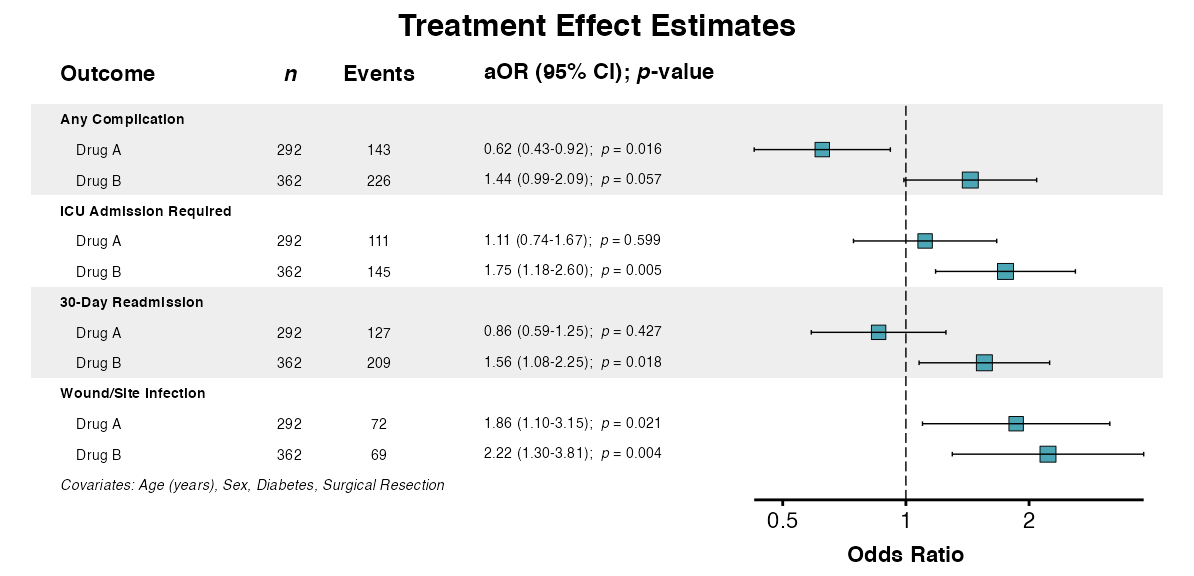
##> 7:   Wound/Site Infection Treatment Group (Drug A)    288     70 2.14 (1.32-3.55)  0.002 1.86 (1.11-3.19)   0.021
##> 8:   Wound/Site Infection Treatment Group (Drug B)    355     66 1.54 (0.95-2.55)  0.084 2.22 (1.31-3.87)   0.004

## Forest plot visualization
forest_plot <- multiforest(
  adjusted,
  title = "Treatment Effect Estimates",
  column = "adjusted",
  indent_predictor = TRUE,
  zebra_stripes = TRUE,
  table_width = 0.65,
  labels = clintrial_labels
)
Parameter Reference
| Parameter | Description |
|---|---|
outcomes |
Character vector of outcome variable names |
predictor |
Single predictor variable name |
covariates |
Optional adjustment covariates |
interactions |
Interaction terms (colon notation) |
random |
Random effects formula for mixed models |
strata |
Stratification variable (Cox models) |
cluster |
Clustering variable for robust standard errors |
model_type |
"glm", "lm",
"coxph", "glmer", "lmer",
"coxme"
|
family |
GLM family (default: "binomial") |
columns |
"adjusted", "unadjusted", or
"both"
|
p_threshold |
Filter results by p-value |
labels |
Custom variable labels |
parallel |
Enable parallel processing |
Best Practices
Outcome Selection
- Use compatible outcome types within a single analysis
- Group conceptually related outcomes
- Consider multiple testing adjustments when testing many outcomes
Common Issues
Empty Results
If results are empty, verify:
- Predictor variable exists and has variation
- Outcomes are correctly specified (
Surv()syntax for survival) - Model type matches outcome type
Convergence Warnings
For mixed-effects models, simplify the random effects structure:
## Start with random intercepts only
multifit(data, outcomes, predictor,
         random = "(1|site)",
         model_type = "glmer")
Varying Sample Sizes
Each outcome is modeled separately and fitted to its own complete cases, so outcomes that differ in missingness are fitted to different numbers of observations. The analyzed sample is reported as a range whenever this occurs, as in Example 7. Estimates remain valid for the observations each model used, but comparisons across outcomes are made on partially different samples.
Restricting the data to complete cases across all outcomes and covariates places every model on the same observations, at the cost of discarding data:
Many Factor Levels
For predictors with many levels, consider collapsing categories:
clintrial$treatment_binary <- ifelse(clintrial$treatment == "Control",
                                      "Control", "Active")
Other Considerations
Multivariate Regression vs. Univariable Screening
The distinction between multifit() and
uniscreen() is important:
| Function | Tests | Use Case |
|---|---|---|
uniscreen() |
Multiple predictors → One outcome | Variable screening, risk factor identification |
multifit() |
One predictor → Multiple outcomes | Exposure effects, intervention evaluation |
All outcomes in a single multifit() call should be of
the same type (all binary, all continuous, or all survival). Mixing
outcome types produces tables with incompatible effect measures. The
function validates outcome compatibility and issues a warning when mixed
types are detected.
Categorical Outcomes with More Than Two Levels
multifit() supports binary outcomes (via logistic
regression) but not multinomial or ordinal outcomes. If a categorical
outcome with three or more levels is included (e.g., treatment group
with “Control”, “Drug A”, “Drug B”), the function will issue a warning
because binomial GLM coerces such variables to binary (first level
vs. all others).
For multilevel categorical outcomes, use dedicated packages outside
of summata:
## Multinomial regression (unordered categories)
library(nnet)
model <- multinom(treatment ~ age + sex + stage, data = clintrial)

## Ordinal regression (ordered categories)
library(MASS)
model <- polr(grade ~ age + sex + stage, data = clintrial, Hess = TRUE)
Further Reading
-
Descriptive Tables:
desctable()for baseline characteristics -
Regression Modeling:
uniscreen(),fit(), andfullfit() -
Model Comparison:
compfit()for comparing models - Table Export: Export to PDF, Word, and other formats
- Forest Plots: Visualization of regression results
- Advanced Workflows: Interactions and mixed-effects models